
Reference overview
Eflatun Pınarı Anıtı
Beyşehir Belediyesi · Beyşehir Belediyesi
Read the place guides and stories that draw on this source.
Read with your device’s voice.
From Erbaba to Eşrefoğlu
From Neolithic settlement to Hittite monuments and the medieval town.
The Beyşehir basin’s history begins long before its standing medieval monuments. Erbaba Höyük belongs to the region’s prehistoric settlement story. Considering it alongside mosque, bridge and lakeside town changes the timescale of a visit: people lived in this landscape long before the buildings that now dominate an architectural tour.
A höyük is a mound formed through accumulated occupation and rebuilding, not a single intact building. Archaeological interpretation draws on excavation contexts and the relationship between layers. A visitor looking at a rise in the landscape cannot reproduce that investigation simply by imagining houses upon it.
The district history identifies Erbaba among early settlements. Detailed claims about individual houses or entry from rooftops require excavation publications. Similarity to another Anatolian site is a question to investigate, not permission to import a familiar reconstruction from Çatalhöyük. The same applies to the surroundings: modern fields and shoreline are not a frozen image of the prehistoric environment.
Use Erbaba as a reason to read the basin across several periods. The regional photograph provides context, not a reconstruction or an image of the excavation itself. Establish access separately, avoid walking on protected remains and never collect material. Distinguishing excavated evidence from a suggested interpretation allows the earliest chapter of the region’s story to retain its own questions, rather than becoming a decorative preface to the medieval town.
Reading a mound requires a different pace from visiting a standing monument. There may be no complete facade to photograph and no single room to enter. The interest lies in how archaeological investigation turns relationships between deposits, objects and construction traces into an account of repeated occupation.
Think about the difference between the landscape you can see and a past environment reconstructed through research. A modern shoreline, field boundary or road is a present reference point. It helps locate a visit, but does not automatically explain how the same ground was used in prehistory.
Place Erbaba on a timeline with the Hittite monuments and Eşrefoğlu Mosque. The spaces between those chapters matter as much as the labels. They prevent the region's history from appearing as a smooth procession of buildings and remind you that many forms of life leave less immediately visible remains.
Heritage layers provides that longer view, while Lake life returns to the basin's changing edges. Use them to plan a reading journey even if a site visit is not possible. The value of the prehistoric chapter lies in changing the questions you ask about the region, not simply adding another pin.
Check current access and visiting arrangements locally.
Eflatunpınar
Read reliefs, stone and spring water together.
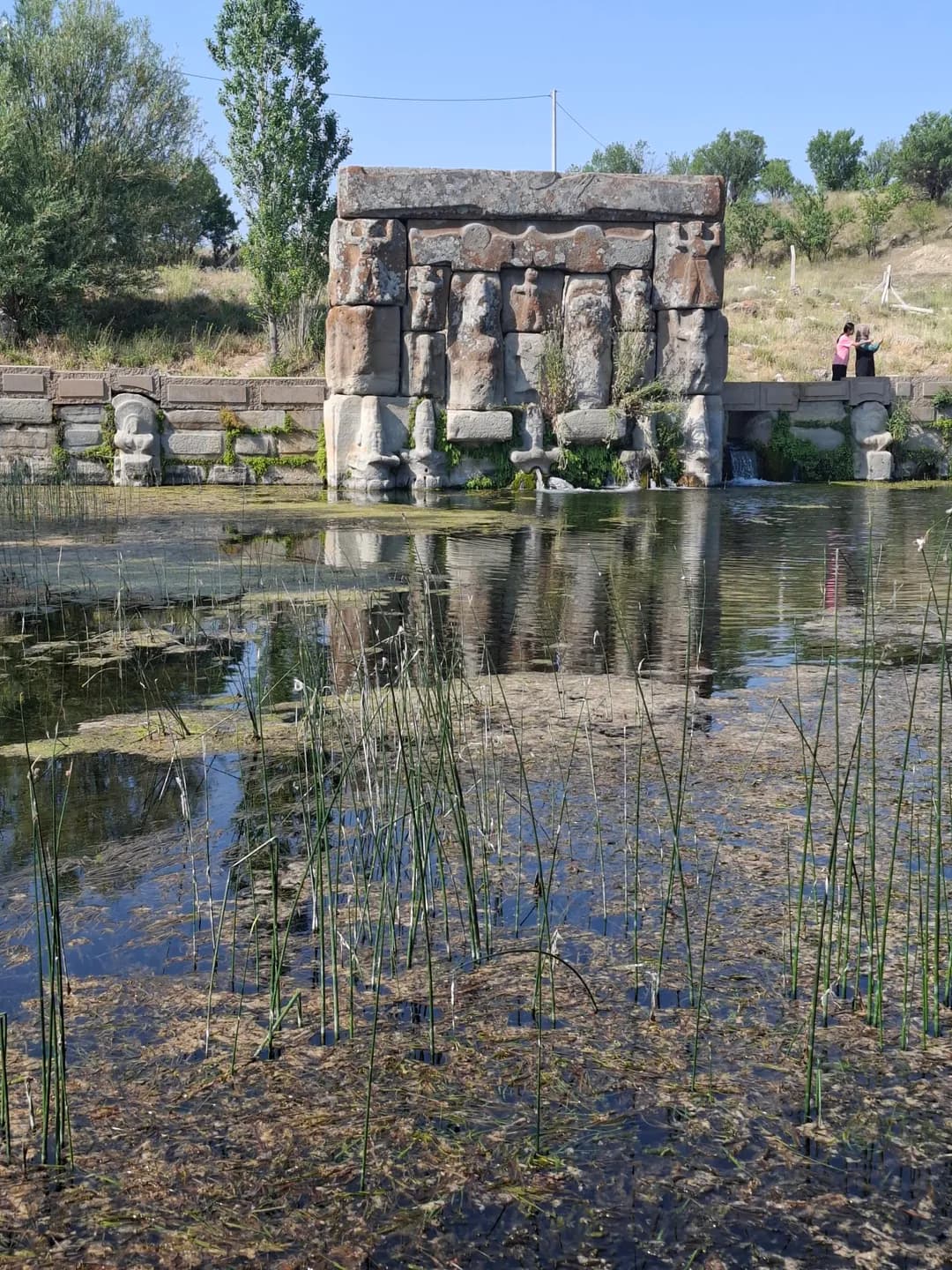
At Eflatunpınar, the spring and carved facade need to be read together. Water gives the setting its physical presence while repeated stone blocks organise the monumental image. Begin with a broad view of pool, masonry and reliefs before trying to name individual figures. The relationship between these elements is more revealing than a detached close-up of one carving.
The heritage sources identify the place with Hittite sacred architecture. That context explains why a spring could receive elaborate treatment, but does not give a certain meaning to every worn form. Some identifications depend on comparison and specialist readings. Observation and interpretation should remain distinct, particularly where weathering makes details difficult to recognise.
Look at how seams between stones interact with the carved composition. A monument assembled from blocks involves alignment and construction as well as sculpture. Water introduces another question: how does the built arrangement respond to a natural source? Reading the pool as an ornamental addition to a freestanding image misses that connection.
The photographs record particular light and water conditions. Reflections and vegetation can reveal one part while concealing another. Compare a wide view with details, but do not treat either as a complete survey. Remain in permitted viewing areas, avoid entering the pool and consult the cited accounts for historical interpretation. Fasıllar extends the regional comparison while remaining a separate place with its own evidence.
A useful first photograph includes the pool and the arrangement above it. A second can concentrate on a recognisable group of forms. Comparing the two afterwards helps you remember where a detail belongs, instead of turning the facade into a collection of disconnected symbols without scale or setting.
Water and stone also create different visual rhythms. The masonry holds its alignment while the surface in front of it changes with light and movement. Look at where a reflection is interrupted and where a carved edge remains clear. The encounter involves both a constructed image and conditions that change during the visit.
Compare the monument's assembled blocks with the single large stone at Fasıllar. One invites attention to joins and alignment; the other to the relationship between a continuous mass and its carved face. This material comparison can be made before considering theories about the intended relationship between the sites.
Water and city opens a much later chapter at Beyşehir's regulator. Reading the two accounts together lets you ask how a structure responds to water in different contexts. It is a comparison of questions, not a claim that a Hittite monument and modern irrigation works shared one continuous function.
Reading stone
Scale, water and imagery at Eflatunpınar and Fasıllar.
Eflatunpınar and Fasıllar offer two different encounters with Hittite stonework around Beyşehir. At one, an arrangement of carved blocks belongs to a spring and pool; at the other, a large monolithic carving makes its material and scale immediately apparent. The sites are rewarding to compare because they are different. Treating them as two interchangeable ancient photo stops would miss the questions each one opens.
Eflatunpınar is identified in the municipal heritage account as a Hittite spring monument of the late thirteenth century BCE. Its carved facade stands with a pool, placing water at the centre of the encounter. Begin with that whole arrangement before following individual figures. The setting belongs to an ancient built treatment of a spring, rather than a sculpture subsequently placed beside an attractive pond.
Next, follow the seams between the blocks. Some lines belong to the assembly of the structure; others form part of the carving. Separating those two kinds of line helps the composition become clearer. It also introduces the practical side of making a monument: a large image assembled from pieces requires choices about alignment and the way individual stones contribute to the whole.
Move your attention between a broad view and one detail you can recognise. A weathered outline may look different with a change of light, and a published drawing may identify a form that is difficult to distinguish on site. Use that difference as a reason to look carefully. There is no need to turn every uncertain contour into a confidently named figure in order to appreciate the workmanship.
At Fasıllar, the municipality describes a monumental stone carved with two divine figures arranged one above the other and lions beside the lower figure. Begin with that composition within the whole mass. Its place on the slope makes the relationship between carving and terrain especially apparent, while a tightly cropped image can conceal the scale of the stone.
The word monolith draws attention to that single-stone character. Compare it with the joined blocks at Eflatunpınar and consider the different practical questions each form raises. How does the available surface influence a composition, and how does a viewer read an image distributed across pieces? These questions give a visit direction without requiring an invented reconstruction of tools, labour or an undocumented workday.
Interpretations have proposed relationships between the two monuments, including possible intended placement. Such proposals belong to the history of research and should retain that status. They can be interesting to investigate without becoming an eyewitness story of a stone being abandoned during transport. The surviving objects allow comparison; they do not, on their own, disclose every decision behind their creation.
The wider Fasıllar landscape also contains heritage associated with other periods. The Lukyanos inscription introduces a different kind of object: words on stone, rather than the visual composition of the Hittite monument. Read Ares and Lukyanos for that change of focus, and keep locations, dates and source accounts distinct. Geographical proximity does not make every carved surface part of a single historical episode.
A useful way to organise your photographs is to pair context and detail at each place. First record the monument in its setting from an authorised position; then record a visible feature without approaching protected surfaces. Add the place name to your notes immediately. Two days later, small stone details can be surprisingly easy to confuse when their background has disappeared from the frame.
Plan these sites as regional visits requiring transport and current access information. They are not consecutive stops on a verified pedestrian trail from the old town. Leave enough time to read the setting at each place rather than using the journey only to collect two pictures. Weather and daylight affect what you can see, but no particular lighting condition justifies climbing a monument or entering a restricted area.
On site, keep to permitted areas and leave the stone untouched. Do not wet a surface to make a carving appear clearer, trace it by rubbing or collect material from the ground. A patient look, a photograph taken from a suitable position and a comparison with published documentation offer a fuller experience without altering what the next visitor will find.
Continue with Hittite water cult for a closer reading of Eflatunpınar, Fasıllar monolith for the single-stone monument, and Heritage layers for a longer chronology of the basin. Water and city provides a much later comparison in how building responds to water. Read that as a shared question across very different periods, rather than evidence of an unbroken purpose or one civilisation's direct continuation into another.
Hittite Water and Mountain Cult
Gods holding up the sky and spring waters in the Eflatunpınar andesite reliefs.
At Eflatunpınar, the spring and carved facade need to be read together. Water gives the setting its physical presence while repeated stone blocks organise the monumental image. Begin with a broad view of pool, masonry and reliefs before trying to name individual figures. The relationship between these elements is more revealing than a detached close-up of one carving.
The heritage sources identify the place with Hittite sacred architecture. That context explains why a spring could receive elaborate treatment, but does not give a certain meaning to every worn form. Some identifications depend on comparison and specialist readings. Observation and interpretation should remain distinct, particularly where weathering makes details difficult to recognise.
Look at how seams between stones interact with the carved composition. A monument assembled from blocks involves alignment and construction as well as sculpture. Water introduces another question: how does the built arrangement respond to a natural source? Reading the pool as an ornamental addition to a freestanding image misses that connection.
The photographs record particular light and water conditions. Reflections and vegetation can reveal one part while concealing another. Compare a wide view with details, but do not treat either as a complete survey. Remain in permitted viewing areas, avoid entering the pool and consult the cited accounts for historical interpretation. Fasıllar extends the regional comparison while remaining a separate place with its own evidence.
A useful first photograph includes the pool and the arrangement above it. A second can concentrate on a recognisable group of forms. Comparing the two afterwards helps you remember where a detail belongs, instead of turning the facade into a collection of disconnected symbols without scale or setting.
Water and stone also create different visual rhythms. The masonry holds its alignment while the surface in front of it changes with light and movement. Look at where a reflection is interrupted and where a carved edge remains clear. The encounter involves both a constructed image and conditions that change during the visit.
Compare the monument's assembled blocks with the single large stone at Fasıllar. One invites attention to joins and alignment; the other to the relationship between a continuous mass and its carved face. This material comparison can be made before considering theories about the intended relationship between the sites.
Water and city opens a much later chapter at Beyşehir's regulator. Reading the two accounts together lets you ask how a structure responds to water in different contexts. It is a comparison of questions, not a claim that a Hittite monument and modern irrigation works shared one continuous function.
Related places