
Reference overview
Kubâdâbâd Sarayı
Kâmil Uğurlu / TDV İslâm Ansiklopedisi · Kâmil Uğurlu / TDV İslâm Ansiklopedisi
Read the place guides and stories that draw on this source.
Read with your device’s voice.
Kubadabad Palace
A connection between palace remains and tiles now in museums.
Kubad-Abad can be approached through two very different scales. The lakeside remains invite you to think about a palace as an arrangement of spaces in a landscape. A tile asks for close attention to colour, outline and surface. Moving between those scales is the most rewarding way to read the site: the building explains where decorated surfaces belonged, while the surviving objects give presence to rooms that can no longer be seen complete.
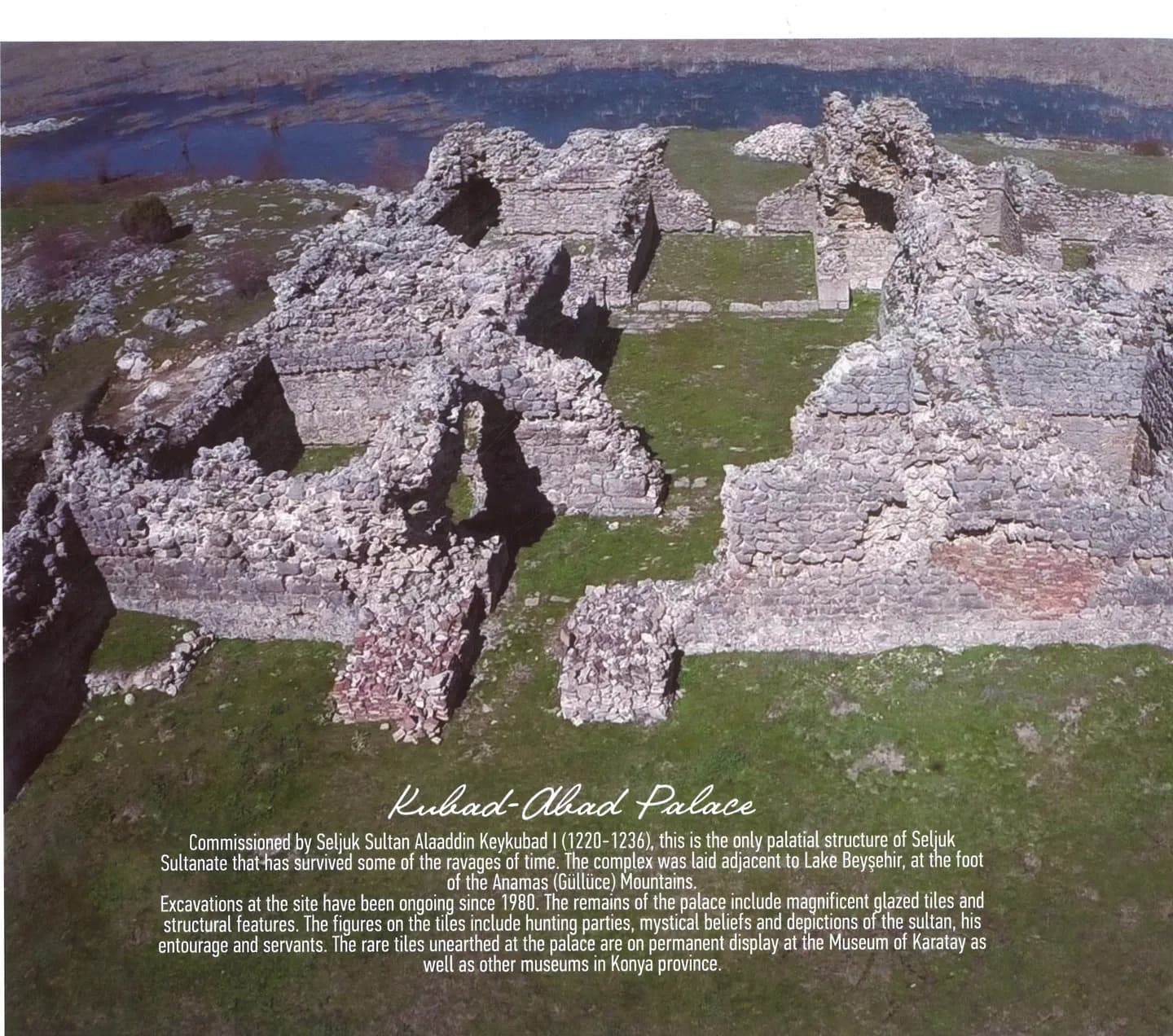
The municipal heritage account associates the palace with Alaaddin Keykubad I and places the complex beside Lake Beyşehir at the foot of the Anamas mountains. Begin with that setting before trying to reconstruct a royal interior. Water, slope and distant skyline belong to the architectural story. The palace was located in a particular environment, not on an empty background that can be removed from the account.
Kâmil Uğurlu's architectural account describes an excavated complex containing two principal palatial buildings, a lakeside boathouse and service buildings. That changes the picture from one isolated royal hall to an organised lakeside site. From permitted viewpoints, consider how surviving walls mark spaces within that larger arrangement. Palace life required movement, storage and support as well as decorated rooms.
The same account traces the identification of the ruins to M. Zeki Oral's work with written sources and records excavation campaigns under Katharina Otto-Dorn in the 1960s and Rüçhan Arık from 1980. This is part of the place's modern history: the palace has also been reconstructed as knowledge, through texts, excavation and the comparison of fragments.
Karatay's tiles, documented by Museum With No Frontiers, make the design easier to recognise. Eight-pointed stars were combined with cross-shaped pieces to form larger panels. In the underglaze examples, black, turquoise and dark blue decoration appears beneath a transparent glaze. Look first at this relationship between outline and colour; the shapes are part of a joined surface, not simply independent pictures.
The same collection account describes human and animal figures, including fantastic creatures and double-headed eagles. Stars frequently carry figures, while connecting pieces often carry vegetal decoration. Follow how the designer fills a star's points and centre. The distinction between a single figure and a repeated wall arrangement gives the tiles both an intimate scale and an architectural one.
Colour adds another layer. Glazed surfaces respond differently to lighting, photography and museum display, so reproductions do not always make the same object look identical. Compare the pattern and outline as well as the apparent hue. The aim is to understand how decorated pieces contribute to an interior, rather than to use a single screen image as an exact reference for the original colour of an entire palace.
Seeing material in a museum is a separate part of the journey. The municipality points readers towards collections in Konya, including Karatay, for excavated tiles. Check current display arrangements with the relevant museum before travelling for a particular object. The lake site offers the relationship between building and landscape; a collection allows a closer encounter with surviving objects and their documentation.
Back in Beyşehir, Eşrefoğlu Mosque offers a useful comparison in how materials guide attention. Timber columns organise a large space; fittings and decorated surfaces focus a closer look. These places differ in patronage, function and survival, and should not be collapsed into a single generic 'Seljuk interior'. Comparing them is valuable precisely because each asks you to move between architectural scale and individual workmanship.
Island communities offers another lake connection through surviving structures and the relationship between land and water. Read it after the palace account to widen the frame beyond a single site. The comparison concerns landscape and ways of interpreting remains; it is not a claim that every island building belonged to one palace complex or can be assigned to the same period.
Plan Kubad-Abad as a regional visit with its own access arrangements, not as a short extension of the old-town walking route. Check whether the archaeological site is accessible and which areas may be visited. Stay within permitted paths, leave loose material in place and allow time for the outward and return journey. A concise visit to an accessible viewpoint is preferable to assuming that every visible ruin is open for exploration.
Afterwards, organise your photographs into three groups: landscape, surviving architecture and individual objects. Write down where each image was made, especially when a museum visit forms part of the same trip. Read Palace tiles alongside Lake life and the mosque's Mihrab and minbar story. Together they make material, setting and present-day experience part of one connected journey without blurring the identity of the places.
Traces of a palace in tile
A story connecting Kubadabad to museum galleries.
Kubad-Abad can be approached through two very different scales. The lakeside remains invite you to think about a palace as an arrangement of spaces in a landscape. A tile asks for close attention to colour, outline and surface. Moving between those scales is the most rewarding way to read the site: the building explains where decorated surfaces belonged, while the surviving objects give presence to rooms that can no longer be seen complete.
The municipal heritage account associates the palace with Alaaddin Keykubad I and places the complex beside Lake Beyşehir at the foot of the Anamas mountains. Begin with that setting before trying to reconstruct a royal interior. Water, slope and distant skyline belong to the architectural story. The palace was located in a particular environment, not on an empty background that can be removed from the account.
Kâmil Uğurlu's architectural account describes an excavated complex containing two principal palatial buildings, a lakeside boathouse and service buildings. That changes the picture from one isolated royal hall to an organised lakeside site. From permitted viewpoints, consider how surviving walls mark spaces within that larger arrangement. Palace life required movement, storage and support as well as decorated rooms.
The same account traces the identification of the ruins to M. Zeki Oral's work with written sources and records excavation campaigns under Katharina Otto-Dorn in the 1960s and Rüçhan Arık from 1980. This is part of the place's modern history: the palace has also been reconstructed as knowledge, through texts, excavation and the comparison of fragments.
Karatay's tiles, documented by Museum With No Frontiers, make the design easier to recognise. Eight-pointed stars were combined with cross-shaped pieces to form larger panels. In the underglaze examples, black, turquoise and dark blue decoration appears beneath a transparent glaze. Look first at this relationship between outline and colour; the shapes are part of a joined surface, not simply independent pictures.
The same collection account describes human and animal figures, including fantastic creatures and double-headed eagles. Stars frequently carry figures, while connecting pieces often carry vegetal decoration. Follow how the designer fills a star's points and centre. The distinction between a single figure and a repeated wall arrangement gives the tiles both an intimate scale and an architectural one.
Colour adds another layer. Glazed surfaces respond differently to lighting, photography and museum display, so reproductions do not always make the same object look identical. Compare the pattern and outline as well as the apparent hue. The aim is to understand how decorated pieces contribute to an interior, rather than to use a single screen image as an exact reference for the original colour of an entire palace.
Seeing material in a museum is a separate part of the journey. The municipality points readers towards collections in Konya, including Karatay, for excavated tiles. Check current display arrangements with the relevant museum before travelling for a particular object. The lake site offers the relationship between building and landscape; a collection allows a closer encounter with surviving objects and their documentation.
Back in Beyşehir, Eşrefoğlu Mosque offers a useful comparison in how materials guide attention. Timber columns organise a large space; fittings and decorated surfaces focus a closer look. These places differ in patronage, function and survival, and should not be collapsed into a single generic 'Seljuk interior'. Comparing them is valuable precisely because each asks you to move between architectural scale and individual workmanship.
Island communities offers another lake connection through surviving structures and the relationship between land and water. Read it after the palace account to widen the frame beyond a single site. The comparison concerns landscape and ways of interpreting remains; it is not a claim that every island building belonged to one palace complex or can be assigned to the same period.
Plan Kubad-Abad as a regional visit with its own access arrangements, not as a short extension of the old-town walking route. Check whether the archaeological site is accessible and which areas may be visited. Stay within permitted paths, leave loose material in place and allow time for the outward and return journey. A concise visit to an accessible viewpoint is preferable to assuming that every visible ruin is open for exploration.
Afterwards, organise your photographs into three groups: landscape, surviving architecture and individual objects. Write down where each image was made, especially when a museum visit forms part of the same trip. Read Palace tiles alongside Lake life and the mosque's Mihrab and minbar story. Together they make material, setting and present-day experience part of one connected journey without blurring the identity of the places.
Beyşehir in Travelers’ Accounts
Eastern and Western voyagers describing Eşrefoğlu Mosque, Kubadabad tiles and island communities.
Travel writing offers an earlier Beyşehir through the choices of people passing through. One visitor notices a building, another a crossing or the circumstances of a stay. These observations can be valuable, but they are selections rather than a complete inventory. Reading them beside the present-day town is a rewarding exercise precisely because the views differ.
Hüseyin Muşmal’s study compares travel accounts and works of historical geography. Descriptions from different dates and purposes reveal changes in emphasis as well as possible changes in places. A memorable sentence cannot carry a neighbourhood’s entire history. Nor should a later summary be mistaken for the original traveller’s exact words.
The writer’s position matters. A short-term visitor and a resident do not see the same town, and an account may have been edited or translated long after the journey. Travel date, publication date and photograph date are different evidence. The historical aerial illustration here provides urban context; it does not prove a traveller’s precise route or establish every old street name’s modern equivalent.
Choose one visible feature and compare its treatment in the sources. Ask what a writer observed directly and what was reported second-hand. Avoid turning an uncertain identification into a plaque-like certainty. Moving between place and text while retaining differences between witnesses produces a richer reading walk than collecting quotations detached from their setting.
Read a travel account with a small set of questions in mind: who is speaking, when did the visit take place and what brought the writer to the town? A description prepared for other travellers may notice different things from a geographical survey or a personal recollection.
Choose a recognisable subject, such as the lake or a crossing, and compare how two accounts frame it. One may emphasise movement, another appearance or the circumstances of a stay. Difference is useful evidence of perspective, even when neither passage can settle a precise architectural question.
Then make your own short description from a public viewpoint. Record the date and distinguish what you saw from what you had already read. Revisiting that note afterwards is a practical way to understand how every account selects and arranges details, including your own.
Market memory and Water and city offer places for this exercise, while Wartime Beyşehir introduces a very different kind of temporary presence. Read the journeys in their own circumstances rather than treating every visitor as a tourist. The reason someone arrived shapes what their account can tell us.
Related places