
Reference overview
Eşrefoğlu Hamamı / Bathhouse
Beyşehir Belediyesi · Beyşehir Belediyesi
Read the place guides and stories that draw on this source.
Read with your device’s voice.
Bedesten
A pause beneath the domes at the heart of the old town.
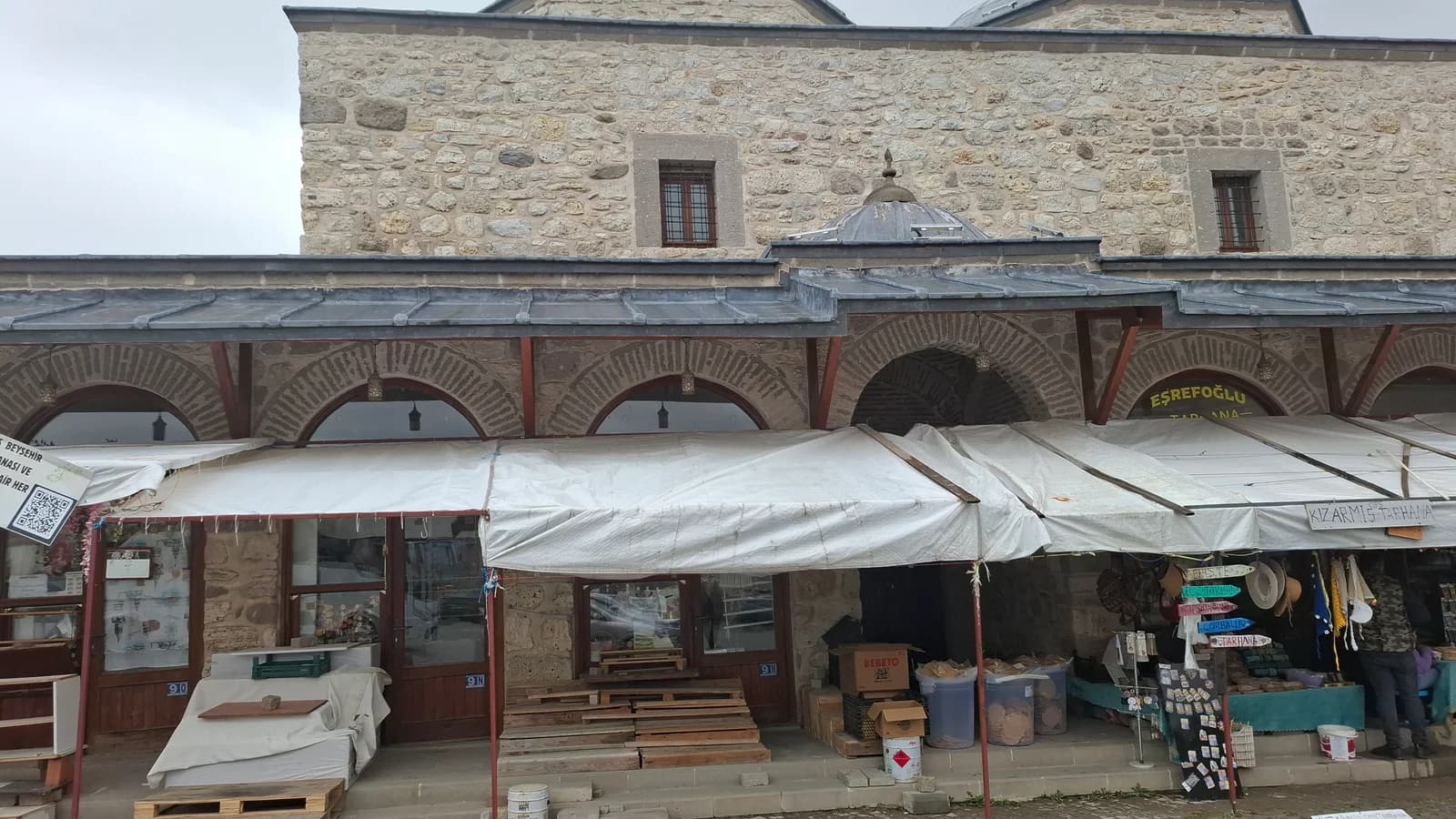
Beyşehir’s Bedesten is a useful place to think about the town as a network of everyday activities. A covered market is more than a picturesque building beside a famous mosque. Its entrances, sheltered interior and domed roof belong to the organisation of exchange: people arriving, goods changing hands and routes through the neighbourhood meeting at a recognisable place.
The municipal heritage accounts describe the building and its repairs. Read the market as a structure shaped by successive uses and interventions. Its construction date is disputed across the sources, while its form and place in the neighbourhood offer a clear starting point for a visit. Look at the roof, entrances and surrounding streets to understand how a sheltered trading space meets the town outside.
Look at the repeated bays and the relationship between roof and walls. Then consider the entrances from the street: where does an approach become a threshold, and how does the covered space change movement? Follow those changes at walking pace, moving from the exposed street into the sheltered threshold. The neighbouring mosque and bathhouse extend the story through their own histories of worship, trade and daily life.
Complete the visit by walking between the market and the neighbouring streets. The contrast between a sheltered trading space and the open street makes the building’s purpose easier to imagine. Look back towards the mosque: commerce, worship and domestic life occupied the same compact urban landscape. Ask before photographing someone at work, and take time to notice the smaller doorways and thresholds between the better-known monuments.
A covered market can be read through a simple sequence: approach, entrance, interior and return to the street. Notice where the roof first changes the light, how one opening frames another, and whether the building encourages a direct passage or a pause. Those spatial clues remain useful even when a historic trading function has changed.
Look at the domed units as a repeated arrangement rather than as one continuous roof. Each bay contributes to a larger whole, much as individual shopfronts form the rhythm of a street. Compare the sheltered volume with the mosque's columned hall; both use repetition, but they organise different activities and different kinds of gathering.
The nearby bathhouse broadens this reading from exchange to daily routines. Its more enclosed exterior creates a different threshold from the market entrance. Walking between the two makes it possible to compare building types without assuming that the same people used them in precisely the same way through every period.
Continue with Beyşehir's table for food and preparation, or Artisans of Huğlu and Üzümlü for work beyond the town centre. These connections give the market story a human scale. If someone shares a memory of the building, note the speaker and occasion; a personal recollection adds a distinct voice alongside the architectural evidence.
Eşrefoğlu Bathhouse
Another layer of historic daily life near the Bedesten.
A bathhouse adds everyday life to a walk often remembered for its monumental mosque. Eşrefoğlu Hamamı belongs to the historic neighbourhood’s network of buildings serving different needs. Seen beside the places of worship and exchange, it helps explain the old town as a setting for daily routines as well as ceremonial occasions.
Start with the building’s exterior and its position in the street. A bathhouse organises movement between spaces with different functions, while its enclosed form presents a different relationship with daylight from an open market entrance or mosque portal. The municipal account provides the historical reference for this stop.
Continue the comparison outside: consider the distance to the mosque and market, and how a person might encounter several kinds of building in one short walk. Present access and use need to be checked locally. Even an exterior visit can add another layer to the neighbourhood’s story, shifting attention from the exceptional monument to the practical architecture surrounding it.
The bathhouse invites attention to buildings that supported everyday life around the more famous mosque. Its significance is partly relational: how close it stands to other uses, how its exterior meets the street and what kind of entrance it presents. These questions can be explored even when only an exterior visit is possible.
Compare an enclosed wall with an open market entrance. They organise light, privacy and movement differently. Avoid treating every historic building as a hall designed to be seen at once. Some kinds of architecture are understood through a sequence of spaces, and an outside view only begins that account.
The term külliye helps introduce a broader network of functions, but nearby buildings still need their own histories. Read the bathhouse's source alongside the mosque account rather than automatically assigning the same date or patron to every neighbour. Physical proximity is the beginning of a question, not its complete answer.
From a public place, include a section of the surrounding street in a photograph. The image will show how the building belongs to the neighbourhood rather than presenting it as an isolated museum object. Leave residents and current users room to enter and pass as you look.
Market memory and Beyşehir's table develop other forms of everyday activity, while A world held by wood returns to the monumental interior nearby. Reading these subjects together gives the old town a fuller character: worship, exchange, preparation and personal routines occupying a shared urban setting.
The memory of the market
The Bedesten and its relationship with nearby streets.
Beyşehir’s Bedesten is a useful place to think about the town as a network of everyday activities. A covered market is more than a picturesque building beside a famous mosque. Its entrances, sheltered interior and domed roof belong to the organisation of exchange: people arriving, goods changing hands and routes through the neighbourhood meeting at a recognisable place.
The municipal heritage accounts describe the building and its repairs. Read the market as a structure shaped by successive uses and interventions. Its construction date is disputed across the sources, while its form and place in the neighbourhood offer a clear starting point for a visit. Look at the roof, entrances and surrounding streets to understand how a sheltered trading space meets the town outside.
Look at the repeated bays and the relationship between roof and walls. Then consider the entrances from the street: where does an approach become a threshold, and how does the covered space change movement? Follow those changes at walking pace, moving from the exposed street into the sheltered threshold. The neighbouring mosque and bathhouse extend the story through their own histories of worship, trade and daily life.
Complete the visit by walking between the market and the neighbouring streets. The contrast between a sheltered trading space and the open street makes the building’s purpose easier to imagine. Look back towards the mosque: commerce, worship and domestic life occupied the same compact urban landscape. Ask before photographing someone at work, and take time to notice the smaller doorways and thresholds between the better-known monuments.
A covered market can be read through a simple sequence: approach, entrance, interior and return to the street. Notice where the roof first changes the light, how one opening frames another, and whether the building encourages a direct passage or a pause. Those spatial clues remain useful even when a historic trading function has changed.
Look at the domed units as a repeated arrangement rather than as one continuous roof. Each bay contributes to a larger whole, much as individual shopfronts form the rhythm of a street. Compare the sheltered volume with the mosque's columned hall; both use repetition, but they organise different activities and different kinds of gathering.
The nearby bathhouse broadens this reading from exchange to daily routines. Its more enclosed exterior creates a different threshold from the market entrance. Walking between the two makes it possible to compare building types without assuming that the same people used them in precisely the same way through every period.
Continue with Beyşehir's table for food and preparation, or Artisans of Huğlu and Üzümlü for work beyond the town centre. These connections give the market story a human scale. If someone shares a memory of the building, note the speaker and occasion; a personal recollection adds a distinct voice alongside the architectural evidence.
Related places